UP | HOME

Path finding Visualizer

Table of Contents

Description

This is a OCaml script implementing, and visualizing the result and calculation of some path finding algorithms like Dijkstra's and A*. It also have different distance approximations and path optimizing methods.

News

  • 19 Aug 2010: v 1.1. Shows all tiles in cloud (not just the first 10).
  • 31 Jul 2010: Fixed Linux binary download link, added usage information.
  • 30 Jul 2010: Page creation.

Files

I couldn't figure out how to compile the OCaml Curses bindings on Windows, so no Windows binary.

Usage

  • Linux binary:
    • Must be run from a terminnal
    • chmod +x pathvisual
    • ./pathvisual
  • Compiling on Ubuntu
    • tar xzvf pathvisual_1.1.tar.gz
    • cd pathvisual
    • sudo apt-get install ocaml libcurses-ocaml libcurses-ocaml-dev (libcurses-ocaml is in universe)
    • make
    • ./pathvisual

Features

  • Cave-like territory, implemented from roguebasin.roguelikedevelopment.org
    • Also a slow implementation of a properly connected cave (several seconds to generate).
  • Path finding algorithms
  • Distance approximation
    • Proper Pythagorean
    • Approximation |x1 - x2| + |y1 - y2|
  • Path finding algorithm visualization
    • Show tiles being considered at each step.
  • Path optimizer, clean up/optimize a path.
    • Good.
    • Fast. After a path optimization, continue with path point after the optimized part.
  • Path optimizer visualization
    • Show each line-of-sight being considered and if it hits a wall.

Screenshots

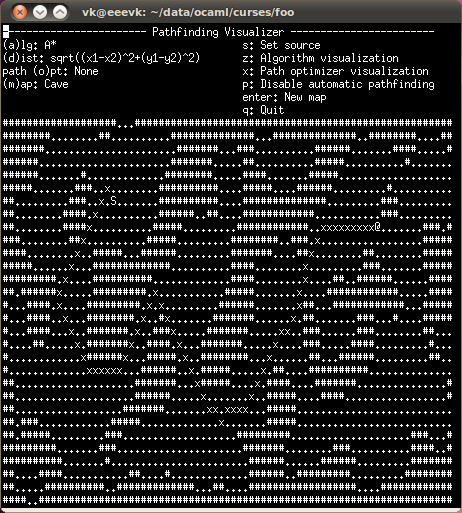
This is a path generated using A*, with the optimal distance algorithm and no path optimization.
files/pathvisual1.png


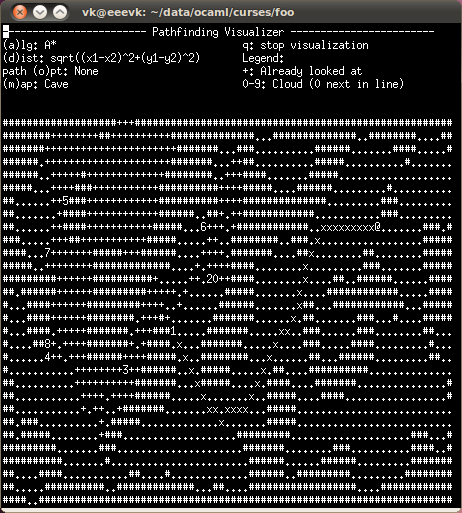
This is the same as in the previous screenshot, but in the middle of a path finding visualization. The + are tiles already visited. 0 is the next tile to be considered (for A* this means the tile with the lowest ("cost from source" + "estimated distance to destination")), the other numbers are the next 9 tiles to be considered.
files/pathvisual2.png


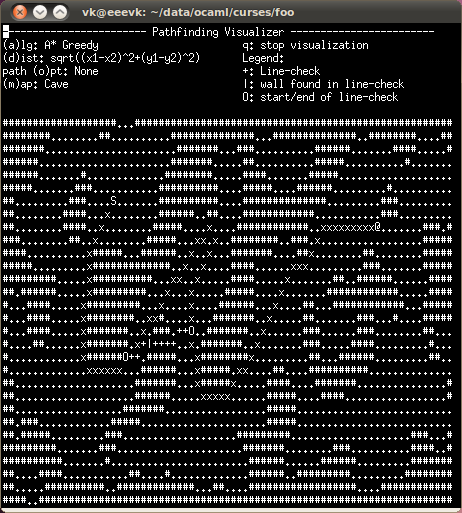
This shows the A* Greedy path finding algorithm in the middle of a path optimization visualization. The O's are the points on the path being checked for possible optimization. The + is the line between the points. And the | is where a wall was found (meaning these 2 points can't be optimized).
files/pathvisual3.png

Why

I wanted to fool around with path finding but had a hard time getting the algorithms working or working fast enough. The solution was adding more and more debugging information, which finally resulted in a visualizer. Also, ML is fun.

Ocamldoc

Code

I put it all in one big file for no-ones convenience.

(** Path Visualizer 1.1

    Version 1.1 19 Aug 2010: Show all tiles in cloud as "9"s (before
    it only showed 10 (from "0" to "9"))

    @since 2010-07-29
    @author Dan Amlund Thomsen <danamlund.gmail.com> www.danamlund.dk
*)

module IntPairHash =
  (struct
     (** Hashtbl mapping from [int * int]. *)

     (** {!module: Hashtbl.S} of [int * int]. *)
     include (Hashtbl.Make (struct 
                              type t = int * int
                              let hash = Hashtbl.hash
                              let equal = (=)
                            end))
                                    
     (** Check if [elt] exists in [hash]. *)
     let exists hash elt =
       try
         find hash elt;
         true
       with _ -> false

     (** Convert a [IntPairHash] to a list of [(key,value)] tuples. *)
     let to_list hash =
       fold (fun k v xs -> (k,v) :: xs) hash []

   end)

module MutBinHeap = 
  (struct
     (** Mutable binary heap of [(int * int) * int * float] using hash
         table for fast delete *)

     type pos = int * int
     type elt = pos * int * float
     type arrayidx = int

     type t = { mutable last : arrayidx;
                mutable arr : elt array;
                hash : arrayidx IntPairHash.t;
                compare : (elt -> elt -> int) }

     let get heap (idx : arrayidx) = 
       if idx >= heap.last
       then raise Not_found
       else Array.get heap.arr idx

     (** Get array index of parent *)
     let parent (i : arrayidx) : arrayidx = i/2

     (** Get array index of left child *)
     let left_child (i : arrayidx) : arrayidx = i*2

     (** Get array index of right child *)
     let right_child (i : arrayidx) : arrayidx = i*2+1

     (** Get element with given pos *)
     let getpos heap pos =
       get heap (IntPairHash.find heap.hash pos)

     (** Swaps 2 array indexes *)
     let swap heap i j =
       let ielt = get heap i in
       let jelt = get heap j in
         Array.set heap.arr i jelt;
         Array.set heap.arr j ielt;
         (match ielt with (ipos,_,_) ->
            IntPairHash.replace heap.hash ipos j);
         match jelt with (jpos,_,_) ->
           IntPairHash.replace heap.hash jpos i

     let rec bubbleup heap idx =
       try
         let parent = (parent idx) in
           if heap.compare (get heap idx) (get heap parent) < 0
           then (swap heap idx parent;
                 bubbleup heap parent)
           else ()
       with
         | _ -> ()

     let rec bubbledown heap idx =
       try
         if heap.compare (get heap idx) (get heap (left_child idx)) > 0
         then (swap heap idx (left_child idx);
               bubbledown heap (left_child idx))
         else
           if heap.compare (get heap idx) (get heap (right_child idx)) > 0
           then (swap heap idx (right_child idx);
                 bubbledown heap (right_child idx))
           else ()
       with 
         | _ -> ()

     (** Make a new binary heap. {[make (fun ((x,y),cost,dist)
         ((x',y'),cost',dist') -> compare ((float cost)
         +. dist) ((float cost') +. dist'))]} makes a binary
         heap comparing cost + distance (A* ) *)
     let make compare = 
       {last = 0;
        arr = Array.make 100 ((0,0),0,0.0);
        hash = IntPairHash.create 100;
        compare = compare}

     (** Insert element into heap *)
     let insert heap elt = 
       (if heap.last >= Array.length heap.arr
        then (let arr' = heap.arr in
                heap.arr <- Array.make (heap.last*2) elt;
                Array.blit arr' 0 heap.arr 0 heap.last));
       Array.set heap.arr heap.last elt;
       (match elt with (pos,_,_) ->
          IntPairHash.replace heap.hash pos heap.last);
       heap.last <- heap.last+1;
       bubbleup heap (heap.last-1)

     (** Remove element {[((x,y),cost,dist)]} where {[(x,y) = pos]} *)
     let remove heap pos =
       try
         let idx = IntPairHash.find heap.hash pos in
           swap heap idx (heap.last-1);
           heap.last <- heap.last-1;
           ignore (bubbleup heap idx);
           ignore (bubbledown heap idx);
           IntPairHash.remove heap.hash pos
       with | _ -> ()

     (** Insert new element or replace existing element with matching
         first. {[replace heap ((2,0),2,3.0)]} would replace the
         existing element {[((2,0),3,5.0)]}. *)
     let replace heap elt =
       match elt with (pos,_,_) ->
         remove heap pos;
         insert heap elt

     (** Returns the minimum element and removes it from the heap. *)
     let pop heap =
       let root = get heap 0 in
         (match root with (pos,_,_) -> remove heap pos);
         root


   end)

module Geometry = 
  (struct
     (** Geometric functions. *)

     (** Bresenham's line algorithm *)
     let rec line (x,y) (x',y') =
       if abs (y'-y) > abs (x'-x) 
       then List.map (fun (y,x) -> (x,y)) (line (y,x) (y',x'))
       else 
         if x > x'
         then List.rev (line (x',y') (x,y))
         else
           let dx = x' - x in
           let dy = abs (y' - y) in
           let error = dx / 2 in
           let ystep = (if y < y' then 1 else -1) in
           let rec loop curx cury error =
             if curx > x'
             then []
             else
               let error' = error - dy in
                 if error' < 0
                 then (curx,cury) :: loop (curx+1) (cury+ystep) (error'+dx)
                 else (curx,cury) :: loop (curx+1) cury error'
           in
             loop x y error
               
   end)       

module IntPairSet = 
  (struct
     (** Set over [int * int] *)

     (** {!module: Set.S} of [int * int]. *)
     include Set.Make (struct type t = int * int 
                              let compare = compare end)
       
     let of_list list =
       List.fold_right (fun x xs -> add x xs) list empty
         
     exception Exception of int * int
   end)

module Cave = 
  (struct
     (** Functions to create and modify caves. *)

     type wall_types = WALL | FLOOR
     type t = wall_types array array

     (** Make a new cave of dimensions initialized to consist of
         [WALL]s *)
     let make x y : t =
       Array.make_matrix x y WALL

     (** Make a new cave initialized to [init] *)
     let makeinit x y init : t =
       Array.make_matrix x y init

     (** Iterate over cave elements. {[iter (fun w -> print_string
         (string_of_wall w)) (fun () -> print_newline ()) cave]} will
         print cave *)
     let iter f f' (cave : t) =
       Array.iter (fun xs -> Array.iter f xs; f' ()) cave
         
     let map f (cave : t) =
       Array.map (fun xs -> Array.map f xs) cave
         
     let copy (cave : t) : t =
       let cave1' = Array.copy cave in
         Array.iteri
           (fun i xs -> Array.set cave1' i (Array.copy xs))
           cave;
         cave1'
           
     let set (cave : t) x y elt =
       Array.set cave.(y) x elt

     let fold_right f f' (cave : t) i =
       Array.fold_right 
         (fun xs rest -> f' (Array.fold_right f xs i) rest) 
         cave i
         
     let mapi f (cave : t) =
       Array.mapi
         (fun y xs -> 
            Array.mapi 
              (fun x w -> f x y w)
              xs)
         cave
         
     let string_of_wall w = match w with
       | WALL -> "#"
       | FLOOR -> "."
           
     let string_of_cave cave =
       fold_right
         (fun w rest -> (string_of_wall w) ^ rest) 
         (fun a b -> a ^ "\n" ^ b) 
         cave ""
         
     let print cave =
       print_string (string_of_cave cave)
         
     let get (cave : t) x y =
       try
         cave.(y).(x)
       with 
         | Invalid_argument s -> WALL
             
     let is_valid_coor (cave : t) x y =
       try 
         ignore (cave.(y).(x));
         true
       with
         | _ -> false
             
     let wall_neighbours cave x y =
       List.fold_right 
         (fun x rest -> match x with 
            | WALL -> 1 + rest
            | _ -> rest)
         [ get cave (x-1) (y-1); get cave x (y-1); get cave (x+1) (y-1);
           get cave (x-1) y;     get cave x y;     get cave (x+1) y;
           get cave (x-1) (y+1); get cave x (y+1); get cave (x+1) (y+1) ]
         0

     let caveify cave n : t =
       mapi (fun x y w ->
               if wall_neighbours cave x y >= n
               then WALL
               else FLOOR)
         cave
         
     let neighbour_coords' (x,y) =
       [          x,(y-1)
       ; (x-1),y;          (x+1),y;
                  x,(y+1);          ]
     let neighbour_coords (x,y) =
       [ (x-1),(y-1); x,(y-1); (x+1),(y-1);
         (x-1),y;              (x+1),y;
         (x-1),(y+1); x,(y+1); (x+1),(y+1) ]

     let inrangexy (cave : t) x y =
       x >= 0 && y >= 0 &&
         x < Array.length cave && y < Array.length cave.(0)

     let isfloor cave x y =
       get cave x y = FLOOR

     let rec getvalidxy cave =
       let x = Random.int (Array.length cave) in
       let y = Random.int (Array.length cave.(0)) in
         if get cave x y != WALL
         then (x,y)
         else getvalidxy cave

     let intpairset_neighbours cave set =
       IntPairSet.diff 
         (IntPairSet.fold 
            (fun (x,y) tosearch ->
               List.fold_right 
                 (fun (x,y) tosearch' ->
                    if not (inrangexy cave x y)
                    then tosearch'
                    else IntPairSet.add (x,y) tosearch')
                 (neighbour_coords (x,y)) tosearch)
            set set) set
         
     let rec connected cave seen =
       let rec loop seen =
         let seen' = (IntPairSet.filter 
                        (fun (x,y) -> get cave x y != WALL) 
                        (intpairset_neighbours cave seen)) in
           if IntPairSet.is_empty seen'
           then seen
           else loop (IntPairSet.union seen seen')
       in
         loop seen
           
     let find_unconnected cave seen =
       let rec loop (searched, tosearch) =
         if IntPairSet.is_empty tosearch
         then raise Not_found
         else
           (IntPairSet.iter 
              (fun (x,y) -> 
                 if get cave x y = FLOOR && 
                   not (IntPairSet.exists (fun z -> z = (x,y)) seen)
                 then raise (IntPairSet.Exception (x,y))) tosearch;
            let searched' = IntPairSet.union searched tosearch in
              loop (searched', intpairset_neighbours cave searched'))
       in
         try
           loop (seen, intpairset_neighbours cave seen)
         with
           | IntPairSet.Exception (x,y) -> (x,y)
           | Not_found -> raise Not_found

     let find_connected cave (x,y) connected =
       let rec loop seen =
         let seen' = intpairset_neighbours cave seen in
           if IntPairSet.is_empty seen'
           then raise Not_found
           else 
             (IntPairSet.iter 
                (fun (x,y) -> (if (IntPairSet.exists 
                                     (fun z -> z = (x,y)) connected)
                               then raise (IntPairSet.Exception (x,y))))
                seen;
              loop (IntPairSet.union seen seen'))
       in
         try
           loop (IntPairSet.add (x,y) IntPairSet.empty)
         with
           | IntPairSet.Exception (x,y) -> (x,y)
               

     let dig_tunnel cave (x,y) (x',y') =
       let cave' = copy cave in
         List.iter 
           (fun (x,y) -> set cave' x y FLOOR)
           (Geometry.line (x,y) (x',y'));
         cave'

     let rec connect_cave' cave (x,y) seen =
       try
         let unconnected = find_unconnected cave seen in
         let closest_connected = find_connected cave unconnected seen in
         let cave' = dig_tunnel cave unconnected closest_connected in
           connect_cave' cave' unconnected (connected cave' seen)
       with Not_found -> cave
         
     let connect_cave cave =
       let xy = getvalidxy cave in
         connect_cave' cave xy 
           (connected cave (IntPairSet.add xy IntPairSet.empty))
           
     let makecave1 x y p =
       map (fun x -> 
              if (Random.int 100) < p
              then WALL
              else FLOOR)
         (make x y)

     let makecave2 x y =
       caveify
         (caveify
            (caveify
               (map (fun x -> 
                       if (Random.int 100) < 45
                       then WALL
                       else FLOOR)
                  (make x y))
               5)
            5)
         5

     let makecave3 x y =
       connect_cave (makecave2 x y)

     let cave0 = [|[|FLOOR;FLOOR;FLOOR;FLOOR|]; 
                   [|FLOOR;WALL;WALL;FLOOR|]; 
                   [|FLOOR;WALL;WALL;FLOOR|];
                   [|FLOOR;FLOOR;FLOOR;FLOOR|]|]
       
     let cave1 = [|[|FLOOR;WALL;FLOOR;FLOOR;WALL;FLOOR|];
                   [|FLOOR;WALL;WALL;WALL;WALL;FLOOR|];
                   [|FLOOR;WALL;FLOOR;FLOOR;WALL;FLOOR|];
                   [|WALL;WALL;FLOOR;FLOOR;WALL;FLOOR|];
                   [|FLOOR;WALL;WALL;WALL;WALL;FLOOR|];
                   [|FLOOR;FLOOR;FLOOR;FLOOR;FLOOR;FLOOR|];|]
       
     let cave2 = [|[|FLOOR;FLOOR;FLOOR;FLOOR|]; 
                   [|FLOOR;FLOOR;FLOOR;FLOOR|]; 
                   [|FLOOR;FLOOR;FLOOR;FLOOR|];
                   [|FLOOR;FLOOR;FLOOR;FLOOR|]|]

   end)         

module PathFinding =
  (struct
     (** Pathfinding functions. *)

     type pos = int * int
     type path = pos list
     type hash_from_pos_to_int = int IntPairHash.t
     type heap_of_pos_cost_dist = MutBinHeap.t
     type distance_function = pos -> pos -> float

     let dist_simple ((x,y) : pos) ((x',y') : pos) = 
       float ((abs (x-x')) + (abs (y-y')))
     let dist_euclid ((x,y) : pos) ((x',y') : pos) =
       sqrt ((float (x-x') ** 2.0) +. (float (y-y') ** 2.0))
         
     let rec string_of_path (path : path) = match path with
       | ((x,y) :: path') ->
           "(" ^ (string_of_int x) ^ "," ^ (string_of_int y) ^ 
             ") " ^ string_of_path path'
       | [] -> "\n"
           
     let path (src : pos) (dst : pos) (visited : hash_from_pos_to_int) : path =
       let rec lowercost xs cost = match xs with
         | (x :: xs') ->
             if try IntPairHash.find visited x < cost with _ -> false
             then x
             else lowercost xs' cost
         | [] -> raise Not_found
       and loop x =
         try
           if x = src
           then [src]
           else (loop (lowercost 
                         (Cave.neighbour_coords x) 
                         (IntPairHash.find visited x)))
             @ [x]
         with _ -> []
       in
         loop dst
           
     let lineofsight (src : pos) (dst : pos) (f : pos -> bool) =
       let rec loop xs = match xs with
         | (x :: xs') ->
             if f x
             then loop xs'
             else false
         | [] -> true
       in
         loop (Geometry.line src dst)

     let path_opt'' cave ((seen : path), (notseen : path), 
                          (tocheck : path), havechecked) foundf =
       match notseen with
         | (xy :: notseen') ->
             (match tocheck with
                | (xy2 :: tocheck') ->
                    if lineofsight xy xy2 
                      (fun (x,y) -> Cave.get cave x y != Cave.WALL)
                    then foundf seen notseen havechecked xy xy2
                    else (seen, notseen, tocheck', xy2 :: havechecked)
                | [] ->
                    (seen @ [xy], notseen', List.rev notseen', []))
         | [] ->
             (seen, notseen, tocheck, havechecked)
     let path_opt' cave path = ([], path, List.rev (List.tl path), [])
     let path_opt cave path foundf =
       let rec loop (seen, notseen, tocheck, havechecked) =
         match notseen with
           | [] -> seen
           | _ -> loop (path_opt'' cave 
                          (seen, notseen, tocheck, havechecked) foundf)
       in
         loop (path_opt' cave path)
     let path_opt_good_foundf seen notseen havechecked xy xy2 =
       let notseen'' = List.tl ((Geometry.line xy xy2) @ havechecked) in
         (seen @ [xy], notseen'', List.rev notseen'', [])
     let path_opt_good cave path = path_opt cave path path_opt_good_foundf
     let path_opt_fast_foundf seen notseen havechecked xy xy2 =
       (seen @ (Geometry.line xy xy2), havechecked, List.rev havechecked, [])
     let path_opt_fast cave path = path_opt cave path path_opt_fast_foundf
       
     exception Exception_intpairhash of int IntPairHash.t
       
     let pathfindingloop cave src dst f' f'' dist =
       let rec loop (visited, waiting) =
         try
           loop (f'' cave dst visited waiting dist)
         with
           | Exception_intpairhash visited -> visited
           | _ -> IntPairHash.create 1
       in
         path src dst (loop (f' cave src dst))
           
     let astar'' cave dst (visited : hash_from_pos_to_int) 
         (waiting : heap_of_pos_cost_dist) (dist : distance_function) =
       let (src,cost,_) = MutBinHeap.pop waiting in
         IntPairHash.replace visited src cost;
         if src = dst
         then raise (Exception_intpairhash visited)
         else
           ((List.iter 
               (fun (x,y) -> 
                  if Cave.get cave x y != Cave.WALL 
                    && not (IntPairHash.exists visited (x,y))
                    && (try 
                          let (_,cost',_) = MutBinHeap.getpos waiting (x,y) in
                            cost < cost'
                        with _ -> true)
                  then (MutBinHeap.replace waiting 
                          ((x,y), cost+1, dist (x,y) dst)))
               (Cave.neighbour_coords src));
            (visited, waiting))
     let astar' cave src dst =
       let waiting = (MutBinHeap.make 
                        (fun (_,ac,ah) (_,bc,bh) -> 
                           compare ((float ac) +. ah) ((float bc) +. bh))) in
         MutBinHeap.replace waiting (src, 0, max_float);
         (IntPairHash.create 100, waiting)
     let astar cave src dst dist =
       pathfindingloop cave src dst astar' astar'' dist
         
         
     let rec dijkstra'' = astar''
     let dijkstra' cave src dst =
       let waiting = (MutBinHeap.make 
                        (fun (_,ac,ah) (_,bc,bh) -> 
                           compare ac bc)) in
         MutBinHeap.replace waiting (src, 0, max_float);
         (IntPairHash.create 100, waiting)
     let dijkstra cave src dst dist =
       pathfindingloop cave src dst dijkstra' dijkstra'' dist
         
     let greedy_astar'' = astar''
     let greedy_astar' cave src dst =
       let waiting = (MutBinHeap.make 
                        (fun (_,ac,ah) (_,bc,bh) -> 
                           compare ah bh)) in
         MutBinHeap.replace waiting (src, 0, max_float);
         (IntPairHash.create 100, waiting)
     let greedy_astar cave src dst dist =
       pathfindingloop cave src dst greedy_astar' greedy_astar'' dist

   end)         


module UI =
  (struct
     (** Interface in Curses for visualizing pathfinding functions in
        caves. *)

     type pos = int * int

     type state = { mutable window : Curses.window;
                    mutable window_cave : Curses.window;
                    mutable cave : (Cave.wall_types array array);
                    mutable cursor : pos;
                    mutable src : pos;
                    mutable dst : pos;
                    mutable path : (int * int) list;
                    mutable alg : int;
                    mutable auto_path : bool;
                    mutable dist_alg : int;
                    mutable path_opt_alg : int;
                    mutable map_type : int;
                    mutable cave_x : int;
                    mutable cave_y : int}

     let printf = Printf.printf
     let sprintf = Printf.sprintf
     let string_of_char = String.make 1

     let getch' n = 
       try
         match n with
           | 260 -> "left"
           | 261 -> "right"
           | 259 -> "up"
           | 258 -> "down"
           | 10 | 343 -> "enter"
           | 331 -> "0"
           | 360 -> "1"
           | 338 -> "3"
           | 339 -> "9"
           | 262 -> "7"
           | n -> string_of_char (char_of_int n)
       with _ -> "unknown"
     let getch () = 
       getch' (Curses.getch ())

     let get_pathfinding n = match n with
       | 0 -> PathFinding.dijkstra
       | 1 -> PathFinding.astar
       | _ -> PathFinding.greedy_astar
     let get_pathfinding_name n = match n with
       | 0 -> "Dijkstra"
       | 1 -> "A*"
       | _ -> "A* Greedy"
           
     let get_dist_alg n = match n with
       | 0 -> PathFinding.dist_simple
       | _ -> PathFinding.dist_euclid
     let get_dist_alg_name n = match n with
       | 0 -> "|x1 - x2| + |y1 - y2|"
       | _ -> "sqrt((x1-x2)^2+(y1-y2)^2)"
           
     let get_path_opt_alg n = match n with
       | 0 -> (fun _ x -> x)
       | 1 -> PathFinding.path_opt_good
       | _ -> PathFinding.path_opt_fast
     let get_path_opt_alg_name n = match n with
       | 0 -> "None"
       | 1 -> "Good"
       | _ -> "Fast"
           
     let get_map_type n = match n with
       | 0 -> Cave.makecave2
       | _ -> Cave.makecave3
     let get_map_type_name n = match n with
       | 0 -> "Cave"
       | _ -> "Connected cave (SLOW)"
           
     let printcave window cave =
       ignore (Curses.move 0 0);
       Cave.iter
         (fun w ->
            ignore (Curses.waddstr window (Cave.string_of_wall w)))
         (fun () -> ignore (Curses.waddstr window "\n"))
         cave
         
     let set_cursor_ifvalid s (x,y) =
       if Cave.isfloor s.cave x y
       then s.cursor <- (x,y)

     let waddstr window x y str =
       ignore (Curses.wmove window y x);
       ignore (Curses.waddstr window str);
       ()

     let refresh s =
       ignore (Curses.wmove s.window 0 0);
       ignore (Curses.wmove s.window_cave 0 0);
       ignore (Curses.wrefresh s.window);
       ignore (Curses.wrefresh s.window_cave)

     let draw_path s =
       let rec loop path = match path with
         | ((x,y) :: path') ->
             waddstr s.window_cave x y "x";
             loop path'
         | [] ->
             ()
       in
         loop s.path;
         match s.src with (src_x,src_y) ->
           match s.dst with (dst_x,dst_y) ->
             waddstr s.window_cave src_x src_y "S";
             waddstr s.window_cave dst_x dst_y "D"
               
     let my_draw s =
       Curses.werase s.window;
       waddstr s.window 0 0 
         ("------------------------ Pathfinding Visualizer "^
            "------------------------");
       waddstr s.window 40 1 "s: Set source";
       waddstr s.window 40 2 "z: Algorithm visualization";
       waddstr s.window 40 3 "x: Path optimizer visualization";
       waddstr s.window 40 4 (sprintf "p: %s automatic pathfinding " 
                                (if s.auto_path
                                 then "Disable"
                                 else "Enable"));
       waddstr s.window 40 5 "enter: New map";
       waddstr s.window 40 6 "q: Quit";
       waddstr s.window 0 1 (sprintf "(a)lg: %s" 
                               (get_pathfinding_name s.alg));
       waddstr s.window 0 2 (sprintf "(d)ist: %s" 
                               (get_dist_alg_name s.dist_alg));
       waddstr s.window 0 3 (sprintf "path (o)pt: %s" 
                               (get_path_opt_alg_name s.path_opt_alg));
       waddstr s.window 0 4 (sprintf "(m)ap: %s" 
                               (get_map_type_name s.map_type));
       printcave s.window_cave s.cave;
       draw_path s;
       match s.cursor with (x,y) ->
         waddstr s.window_cave x y "@";
       refresh s
         
     let debug_path_legend s =
       waddstr s.window 40 1 "q: stop visualization           ";
       waddstr s.window 40 2 "Legend:                         ";
       waddstr s.window 40 3 "+: Already looked at            ";
       waddstr s.window 40 4 "0-9: Cloud (0 next in line)     ";
       waddstr s.window 40 5 "                                ";
       waddstr s.window 40 6 "                                "
         
     let debug_path s =
       let (f,f') = 
         (match s.alg with
            | 0 -> (PathFinding.dijkstra', PathFinding.dijkstra'')
            | 1 -> (PathFinding.astar', PathFinding.astar'')
            | _ -> (PathFinding.greedy_astar', PathFinding.greedy_astar'')) in
       let dist = get_dist_alg s.dist_alg in
       let rec loop (visited, waiting) =
         try
           let print_num waiting n =
             try
               (let ((x,y),_,_) = MutBinHeap.get waiting n in
                  waddstr s.window_cave x y (sprintf "%i" n))
             with | _ -> ()
           in
           let print_cloud waiting =
             let rec loop n = 
               if n >= waiting.MutBinHeap.last
               then ()
               else ((match MutBinHeap.get waiting n with 
                          ((x,y),_,_) -> waddstr s.window_cave x y "9");
                     loop (n+1))
                     in
                 loop 0
             in
               my_draw s;
               debug_path_legend s;
               print_cloud waiting;
               print_num waiting 8;
               print_num waiting 7;
               print_num waiting 6;
               print_num waiting 5;
               print_num waiting 4;
               print_num waiting 3;
               print_num waiting 2;
               print_num waiting 1;
               print_num waiting 0;
             IntPairHash.iter
               (fun (x,y) v -> waddstr s.window_cave x y "+") visited;
             refresh s;
             match getch () with 
               | "q" -> ()
               | _ -> loop (f' s.cave s.dst visited waiting dist)
         with
           | PathFinding.Exception_intpairhash visited ->
               s.path <-
                 (PathFinding.path s.src s.dst
                    visited)
       in
         loop (f s.cave s.src s.dst)
           
     let set_path s =
       s.path <- 
         ((get_path_opt_alg s.path_opt_alg) 
            s.cave
            ((get_pathfinding s.alg s.cave) s.src s.dst 
               (get_dist_alg s.dist_alg)))
         
     let debug_opt_legend s =
       waddstr s.window 40 1 "q: stop visualization           ";
       waddstr s.window 40 2 "Legend:                         ";
       waddstr s.window 40 3 "+: Line-check                   ";
       waddstr s.window 40 4 "|: wall found in line-check     ";
       waddstr s.window 40 5 "O: start/end of line-check      ";
       waddstr s.window 40 6 "                                "
         
     let debug_opt s =
       let (f'', foundf) = 
         (match s.path_opt_alg with
            | 0 -> ((fun _ (x,_,_,_) _ -> (x,[],[],[])), 
                    fun _ _ _ _ _ -> ([],[],[],[]))
            | 1 -> (PathFinding.path_opt'', PathFinding.path_opt_good_foundf)
            | _ -> (PathFinding.path_opt'', PathFinding.path_opt_fast_foundf)) in
       let rec loop (seen, notseen, tocheck, havechecked) = match notseen with
         | [] -> ()
         | _ ->
             let drawline window src dst =
               List.iter (fun (x,y) -> waddstr window x y "+") 
                 (Geometry.line src dst);
               ignore (PathFinding.lineofsight src dst 
                         (fun (x,y) -> 
                            if Cave.get s.cave x y != Cave.WALL
                            then (waddstr window x y "+"; true)
                            else (waddstr window x y "|"; false))); () in
               s.path <- seen @ (List.rev notseen);
               my_draw s;
               debug_opt_legend s;
               (try
                  drawline s.window_cave (List.hd notseen) (List.hd tocheck);
                  (match (List.hd tocheck) with 
                     | (x,y) -> waddstr s.window_cave x y "O");
                  (match (List.hd notseen) with 
                     | (x,y) -> waddstr s.window_cave x y "O")
                with _ -> ());
               refresh s;
               match getch () with 
                 | "q" -> ()
                 | _ -> loop (f'' s.cave (seen, notseen, tocheck, havechecked)
                                foundf)
       in
       let old_path_opt_alg = s.path_opt_alg in
         s.path_opt_alg <- 0;
         set_path s;
         loop (PathFinding.path_opt' s.cave s.path);
         s.path_opt_alg <- old_path_opt_alg;
         set_path s

     let new_map s =
       s.cave <- get_map_type s.map_type s.cave_y s.cave_x;
       s.cursor <- Cave.getvalidxy s.cave;
       s.src <- s.cursor;
       s.dst <- s.cursor;
       s.path <- []
             
     let rec loop s =
       s.dst <- s.cursor;
       (if s.auto_path
        then set_path s);
       my_draw s;
       match getch () with
         | "q" ->
             printf "Quit.\n"
         | "enter" ->
             new_map s;
             loop s
         | "up" | "8" ->
             (match s.cursor with (x,y) ->
                set_cursor_ifvalid s (x, y-1));
             loop s
         | "9" ->
             (match s.cursor with (x,y) ->
                set_cursor_ifvalid s (x+1, y-1));
             loop s
         | "right" | "6" ->
             (match s.cursor with (x,y) ->
                set_cursor_ifvalid s (x+1, y));
             loop s
         | "3" ->
             (match s.cursor with (x,y) ->
                set_cursor_ifvalid s (x+1, y+1));
             loop s
         | "down" | "2" ->
             (match s.cursor with (x,y) ->
                set_cursor_ifvalid s (x, y+1));
             loop s
         | "1" ->
             (match s.cursor with (x,y) ->
                set_cursor_ifvalid s (x-1, y+1));
             loop s
         | "left" | "4" ->
             (match s.cursor with (x,y) ->
                set_cursor_ifvalid s (x-1, y));
             loop s
         | "7" ->
             (match s.cursor with (x,y) ->
                set_cursor_ifvalid s (x-1, y-1));
             loop s
         | "s" ->
             s.src <- s.cursor;
             loop s
         | "a" ->
             s.alg <- (s.alg+1) mod 3;
             loop s
         | "z" ->
             debug_path s;
             loop s
         | "x" ->
             debug_opt s;
             loop s
         | "p" ->
             s.auto_path <- not s.auto_path;
             s.path <- [];
             loop s
         | "d" ->
             s.dist_alg <- (s.dist_alg+1) mod 2;
             loop s
         | "o" ->
             s.path_opt_alg <- (s.path_opt_alg+1) mod 3;
             loop s
         | "m" ->
             s.map_type <- (s.map_type+1) mod 2;
             loop s
         | _ ->
             loop s

     let main () =
       let cave_x = ref 75 in
       let cave_y = ref 30 in
         Arg.parse
           [("-x", Arg.Set_int cave_x, "width of cave");
            ("-y", Arg.Set_int cave_y, "height of cave")]
           (fun _ -> ())
           "Usage: pathvisual [options]";
         let window = Curses.initscr () in
         let window_top = Curses.newwin 7 75 0 0 in
         let window_cave = Curses.newwin (!cave_y+3) (!cave_x+3) 7 0 in
           Random.self_init ();
           at_exit Curses.endwin;
           ignore (Curses.noecho ());
           ignore (Curses.keypad window true);
           let cave = Cave.makecave2 !cave_y !cave_x in
           let xy = Cave.getvalidxy cave in
           let s = {window       = window_top;
                    window_cave  = window_cave;
                    cave         = cave;
                    cursor       = xy;
                    src          = xy;
                    dst          = xy;
                    path         = [];
                    alg          = 0;
                    auto_path    = true;
                    dist_alg     = 0;
                    path_opt_alg = 0;
                    map_type     = 0;
                    cave_x       = !cave_x;
                    cave_y       = !cave_y} in
             ignore (Curses.refresh ());
             loop s
         
           
     let curses_keys () =
       let window = Curses.initscr () in
         at_exit Curses.endwin;
         ignore (Curses.noecho ());
         ignore (Curses.keypad window true);
         let rec loop () =
           ignore (Curses.wmove window 0 0);
           let ch = Curses.getch () in
             ignore (Curses.waddstr window 
                       (sprintf "input: %i name: %s             " 
                          ch (getch' ch)));
             loop ()
         in
           loop ()
            
   end)

Comments


Author: Dan Amlund

Date: 2010-08-19 13:54:06 CEST

HTML generated by org-mode 6.36trans in emacs 23